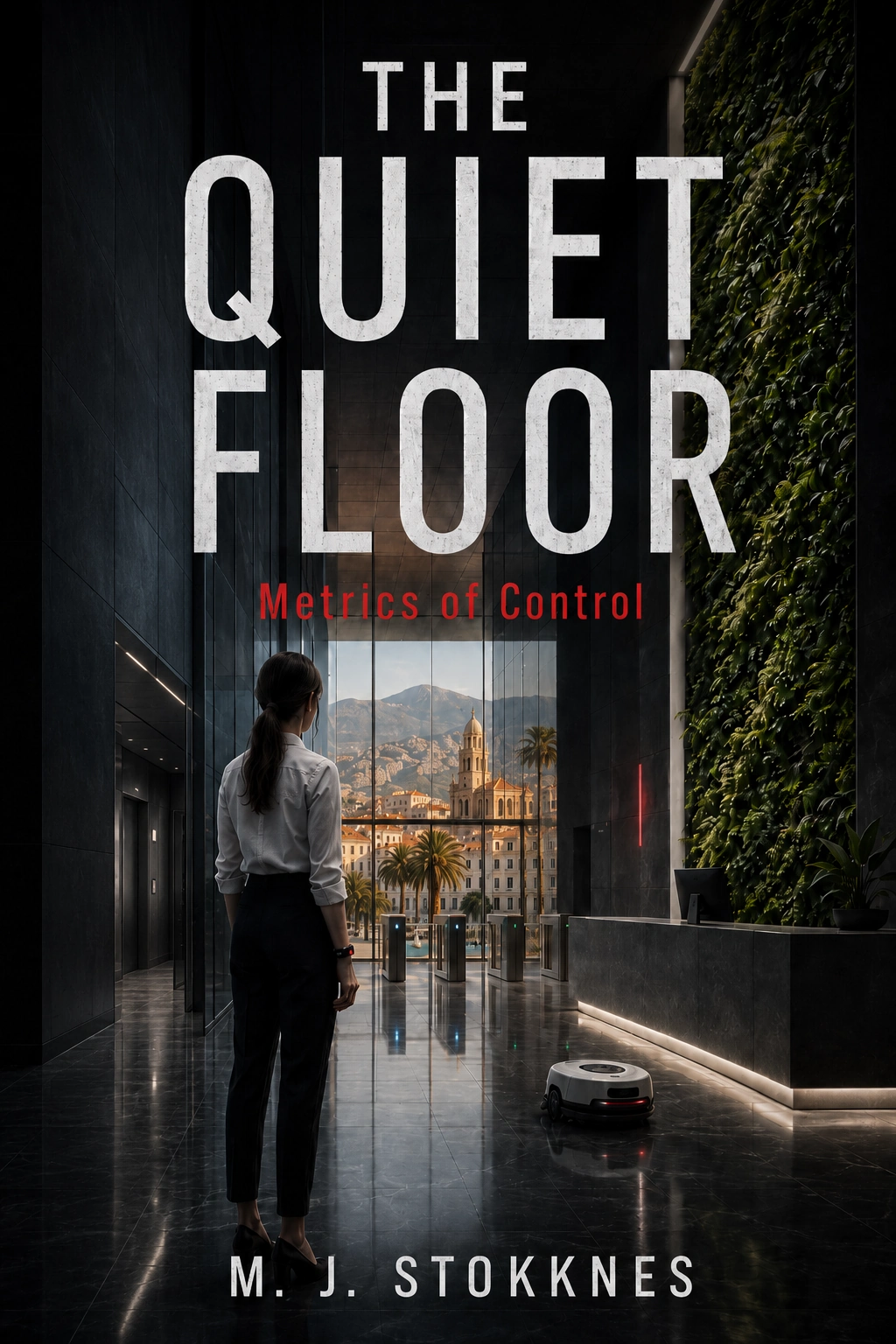
A near-future Málaga novella about workplace surveillance, biometric performance systems, and the point where control learns to speak in the language of care.
Synapse Connect does not present itself as violent. It offers housing, support, wellness, efficiency, and a future in Málaga. Its systems become intimate because employment, access, shelter, and identity are already connected.
The floor measures posture, pulse, tone, hesitation, stress, and the small bodily refusals that appear before a person has language for them. The horror is not that the system misunderstands its workers. It understands them accurately and has commercial reasons to continue.
- Málaga
- workplace surveillance
- metrics
- care language
- autonomy
Read the opening
The first thing Maeva noticed when she stepped out of Málaga María Zambrano station was the heat.
Not warmth. Heat.
It came up from the pavement and down from the white sky and sideways from the buses breathing diesel at the curb. It touched her face with the confidence of a stranger who had already decided they knew her. She stood still for a moment with her suitcase beside her, one hand wrapped around the handle, the other holding her phone, and tried not to look as lost as she felt.
Around her, people moved with purpose. A woman shouted into a phone while dragging a pink suitcase behind her. Two boys in football shirts cut through the crowd, laughing, one of them eating from a paper bag that smelled of oil and salt. An old man leaned against the wall outside the station, smoking with the calm of someone who had survived every government, every crisis, every new system invented to improve his life.
Later, Málaga passed in fragments through the car window: palm trees, apartment blocks, traffic lights, a pharmacy cross blinking green, a woman in black carrying bread, a dog sleeping under a parked scooter, balconies full of laundry that moved slightly in the hot air.
It was beautiful in the wrong way. Too bright to be gentle. Too alive to be safe.
Care as control language
The system converts surveillance into support and compliance into wellbeing.
The quantified body
Biometric measurement turns fatigue, fear, and resistance into operational data.
Málaga behind the glass
Sunlight, tourism, housing, work, and corporate architecture remain visible outside the controlled interior.
“A metric stops describing reality the moment it starts controlling behaviour.”The Stokknes Chaos Framework
For readers of workplace dystopia, corporate horror, surveillance fiction, near-future Málaga, biometric systems, and institutions that become more dangerous as they become more helpful.
Formats and editions
| Format | Status | Price | ASIN | Link |
|---|---|---|---|---|
| Kindle eBook | Live | $5.99 USD | B0H5D1SHL7 | Amazon ↗ |
| Paperback | Live | $19.99 USD | B0H5CJGS4B | Amazon ↗ |
| Hardcover | Live | $29.99 USD | B0H5D539PD | Amazon ↗ |